I’ve had this topic on my mind for awhile and I’m just trying to get it out there. It’s difficult to talk about difficulty because it’s a derivative aspect of a game that is the consequence of many individual gameplay design choices and how the player’s agency engages and collides with them. It’s also highly subjective. “Good” and “bad” are not particularly helpful terms. I’d like to try and take a more critical look at this by investigating some subtopics of difficulty and breaking down what I feel is more “compelling” and what is maybe more … “tedious”?
So let’s talk about some of my favorite and least favorite combat encounters in the Dark Souls series. Quick guidelines: for the sake of my own discussion I’m sticking strictly with Souls I - III and excluding boss fights since they are kind of a separate spectacle. I wanna talk about the nuts and bolt - what makes the sausage. Please feel free to chime in with your own favorites and least favorites, too! (and don’t feel compelled to stick to my guidelines if you want to talk about entirely other games/series)
But first let’s talk about … the basilisk!

You love him, you hate him, you love to hate him; it’s the basilisk!
Honestly one of my favorite Souls enemies, veterans can tell you how dangerous this little guy is. One on one they’re not much trouble as they don’t have much health and are squishy to most damage types. They go down fairly easily and usually don’t deal too much damage themselves. The danger of course comes when you run into a pack of them and they start breathing their curse breath which, once it fills up the status bar, kills you instantly. Having several of these little critters scampering about and spewing curse breath starts to severely limit your mobility and can lead to a quick end even when you think you’re being careful. Fighting them is more about positioning and the developers frequently use them to force the player into movement rather than strictly trying to damage them to death.
Basilisk: First Encounter
If you’re playing through the series in chronological order, the first place you’re likely to encounter these dudes is The Depths. There is a trap that results in you falling into a confined space with several of them. This is delightfully devious as it 1) surprises the player usually causing some amount of panic, 2) obscures an exit route because you cannot simply backtrack, 3) are in a confined space limiting your mobility making the curse breath extra deadly.
Just an A+ encounter, this is the sadistic DM tendencies that people love about From games. Perfect introduction, no notes.
Basilisk: Further Encounters
The next place you’re likely to encounter the basilisk (if you find it) is The Great Hollow. In a complete inversion of the first encounter, you are now in a very open space. Too open in fact, surrounded by fatal falls on almost every side. You’re given the option to either suck fume or toss yourself into the deadly void.
A+, delightful.
My Favorite Combat Encounter: Dark Souls III, Farron Keep

Sticking to the right wall from the ladder to Crucifixion Woods (and along that area’s boundary if I recall correctly) you’ll encounter a cluster of basilisks. There’s not much reason to be back here unless you’re trying to cover every inch of the swamp, but if you are, you’re rewarded with this treacherous little encounter. No trickery this time, you’ll see them come charging straight at you.
The ingredients: you’re in waste deep water so your movement and dodge speed are restricted. The tree roots in the area form impassable tangles and dead-ends making it very easy to lose your backtracking escape route, especially if you’ve already clumsily dodge rolled, resulting in a dangerously confined space for the curse breath to do its thing. You’re in a poison swamp so the poison status is either ticking up or down on you adding further pressure when the second status bar (curse) appears threatening to inflict another effect on you.
New players who started with III and have never seen a basilisk before may just as easily stumble onto this encounter and have no trouble with it, taking out the basilisks before they realize the danger they’re in through beginner’s luck. Experienced players may recognize all the ingredients going into this encounter and the realization of the intense danger may cause them to panic, sealing their doom. All of these ingredients are easily recognized mechanics of the game that have been introduced to the player and have even been present since the first game, but they’ve been put together here.
It’s just a very subtle, expertly crafted encounter that shows how peak the design had become by Dark Souls III when even little, barely explored corners of the map contain things like this.
A+++. Peak Dark Souls, would die again.
My Least Favorite Encounter: Dark Souls II, Harvest Valley
Dark Souls II gets a lot of hate and I insist that if you want to talk shit about it you must first love it. Beginners of the series who have heard bad things and are contemplating skipping it I say: absolutely do not. There’s a lot to love here, as well as a fair amount of flaws. It’s the worst Dark Souls game in my opinion but that’s only because it’s a giant among titans.
One of the weakest aspects of Dark Souls II though is a lot of the combat encounters. The combat itself is perhaps the slowest it’s been in the series and the encounters delight in throwing too many enemies at you. What’s worse is that these encounters aren’t even interesting, they’re just simply overwhelming numbers. See for example the opening areas of The Iron Keep.
But hands down my least favorite encounter, the one that just kinda makes me groan is in Harvest Valley …
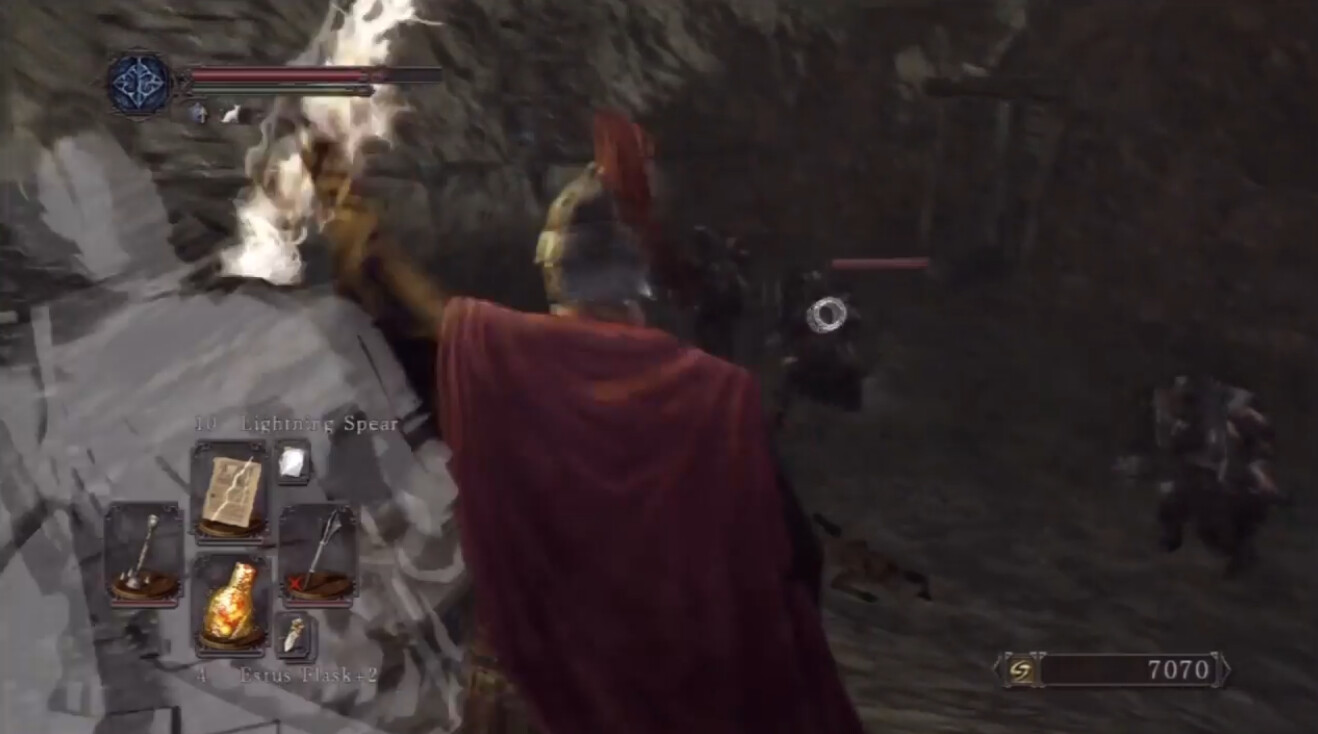
Sorry for the poor picture quality, I just grabbed it from a video. Let’s go over this bit by bit, starting with ….
The entrance. As you enter the arena you’ll notice your character stumble down a thigh-high embankment. That’s right, it’s a one way trap, DSII is full of these. This always feels like lazy level design and is a little insulting to the player’s intelligence as if we couldn’t just scramble backwards. But fine, we’ll continue forward with the encounter.
4 Undead Hunstmen begin to fill the area. They’re slow moving but tanky, both dealing and taking large amounts of damage. No matter your build, there’s really not anyone who is going to stand their ground against 4 of them. So you do what anyone would do and you start running. That’s when you notice the ramp up to a higher level and the whole encounter design becomes clear. You’re meant to kite the 4 of them up the ramp, whittling damage wherever possible until they corner you and you drop back to the lower level. They follow and you repeat the process, downing them one by one. If at any point in this encounter you trip up and die, you must restart the whole process.
A good Souls encounter gives you an interesting combat arena and sets the pieces on the board for you to engage with. They use a variety of tactics to apply pressure such as ambushes to push you forward or ranged attackers picking at you from a distance to pull you forward. There’s often just enough room to pull off a victory, or just enough rope to hang yourself with. Here the encounter has been designed with one solution and it forces you directly into that solution. There is no cleverness in figuring it out, there is no satisfaction in performing it, only tedium from repetition made worse by failing and having to restart at any point.
This is in my opinion, Souls encounters at their lowest.
Continuing the Conversation
Having thus established these two boundaries, it’s now easier for me to break down individual combat encounters. There are still many encounters throughout the series that I personally “hate”, but I can look at them and ask myself if the difficulty is compelling or tedious. Does it derive its challenge from a variety of pressure points forcing the player to consider their positioning or does it bottleneck the player into a slow attrition?
OK that’s it I ran outta steam I hope this was fun, bye!